Showing posts with label Alps. Show all posts

Saturday, 13 August 2011

Portjengrat/Pizzo d'Andolla Topo

Theres not many good photos of the Portjengrat from the Almageller side floating around on the internet and even less with superimposed photo topos so I put the one below together. The Green dashed line in the approach from the Almageller Hut to Port and the Red is the ascent to the Pizzo d'Andolla and the descent.

Portjengrat Traverse AD+ IV (9-10 Hours)

A full route description is given in the Alpine Club's Valais Alps East guidebook by Les Swindon.

Sunday, 7 August 2011

Swiss Classics: Dri Horlini & Portjengrat Traverse

Last week I was in the Swiss Valais Alps for some alpine climbing as a part of the West Lancs Scout Mountaineering group bi-annual alpine trip. We had a day up on the Weismeiss glacier on the first day to refresh skills and gain a bit of acclimatization. The weather has been fairly unsettled in Europe for the last few weeks, with it putting a lot of precipitation down and this could be seen as the area that is usually free of snow during the summer round the top of the Hoshaas lift was in places inches deep.

First tower of the Dri Horlini (three horns).

The next day myself and Ash headed up to the Almageller hut managing to do the appraoch pretty swiftly in 2.45hrs including a half hour for a drink at the Almagelleralp Hotel half way which we we both pretty surprised out as we've both been neglecting cardiovascular activity for the last few months. We checked in at the hut, found out bedroom, had a bite to eat and then decided to go and have a crack at the Dri Horlini Traverse AD in the afternoon as we'd been eying it up on the approach to the hut.

The Dri Horlini (3209m) is a huge rock fin, several hundred meters tall composed of beautiful looking compact orange gneiss. The traverse of its three summits gives wonderful exposed alpine rock climb of mostly UIAA III with a few moves of IV. Theres also a few abseils and down-climbs. There is some fixed protection here and there but we were last of a few nuts and cams. We reached the start in about 15 minutes from the hut and roped up to move together, we moved really sickly probably stopping to redistribute gear or swap over 4-5 times, and we over took a guided party on the ridge. Just as we were getting towards the end of the route the temperature dropped and we spotted a few snow flakes which made us quicken the pace further. We did the route in 1 hours 35 minutes considering the guidebook time is 2-4 hours we were very, very happy with.

Climbing on the traverse.

We spent that evening in the hut with some friends who were attempting the Weismeiss the next day, our plan was to head up and try the Portjengrat Ridge AD+ on the Pizzo d'Andolla. We were a little apprehensive as its a long route, with a guidebook time of 10 hours and neither of us were that acclimatized yet, but with the confidence of knowing we'd done the Horlini in well under guidebook time we decided to give it a go.

Our route started from the col to the left of the smallest peak in the center and followed the ridge obscured from view to the highest peak in the picture.

We got up for the 4am breakfast, and were out of the hut before 4:30am following the approach trail through the moraines and eventually across the now heavily receded glacier to Port, a small col before the Mittelruck. We were here for 6am, half an hour under guidebook time, which was a good start, until we went to get the guidebook out to find the start of the route and found we didn't have it. Dam. We came to the conclusion that route finding couldn't be too hard, it was a ridge route so we couldn't get too lost and we had a rough idea of the descent so we'd give it a go. As a back up we sent a message to Chris to text us a description when he got up.

Section of the Portjengrat, approaching the first of the summit towers.

The first section of the route from Port involved a little downclimbing onto the west face before a wonderful crack system which we moved together up led us to the ridge crest. The ridge climbing continues, and is very exposed with a 300m vertical drop to your right, down into Italy. The climbing is never hard from memory it was all around UIAA III but there were one or two moves of IV.

After 7 hours or so of continuous climbing we reached the summit. I don't know how far we came but we moved together and did several full 50m pitches as well. The climbing was superb all the way along, mostly the rock was sound, there was only one section with some loose rock where microwave sized piece almost took Ash out. We climbed the whole route in boots and gloved hands as it was cold, I took my gloves off twice for the two cruxes I lead. For the most part the ridge was relatively snow free but there were still a few sections where stubborn snow from the recent storm got in the way.

From the summit, we were able to follow a fairly brief and ambiguous route description that Chris has send us - he managed to condense a two page route into the guidebook into a single text message. We traverse some gendarmes and some scary snow bridges/cornices on the ridge before gaining our exit, a hanging glacier which we traversed before crossing another rock ridge and finally ending up back down on the moraine above the hut.

Ash taking a breather on the summit, with more weather coming in.
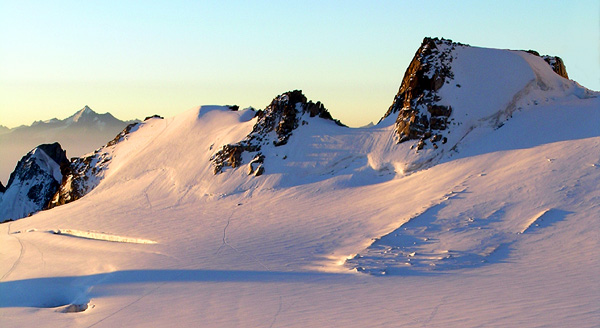
We did the route hut-hut in 11 hours, so an hour over guidebook time. But considering we weren't acclimaitized, didn't have a guidebook and had poor weather (it was snowing on and off all day and visibility was down to 30-50m) we were pleased with our effort. Certainly one of the best if no the best alpine rock route that I've done, I highly recommend it. When describing this to a friend I was trying to think of an analogy in British climbing routes and I think Ceneifon Arete in Snowdonia, but harder climbing (HS rather than Mod), 10x as exposed and 100x as long would be fairly fitting! Go and do it, you won't be disappointed.

Wednesday, 29 September 2010

Cosmiques Arete Solo

Friday saw the good weather we'd been heaving in Cham break and a bank of unsettled low pressure move it for the weekend. Ash an Clare decided to have a valley day at Gaillards the local crag but having done a lot of the route there that are within my grade when I was out in Chamonix last I decided to try and get one more day in up in the mountains before my flight and the definitive end to my sumer alpine season.

The Cosmiques Arete isn't hard, nor is it particularly serious, its very accessible and having done the route many times over the summer due to its proximity to the lift station and preferableness to trudging up the snow arete I now know it pretty dam well. As such it made quite a good objective for a alpine solo. I've never solo'ed anything in the alpine before, and when I say solo I don't mean just climbing un-roped, I'm referring climbing alone on the mountain.


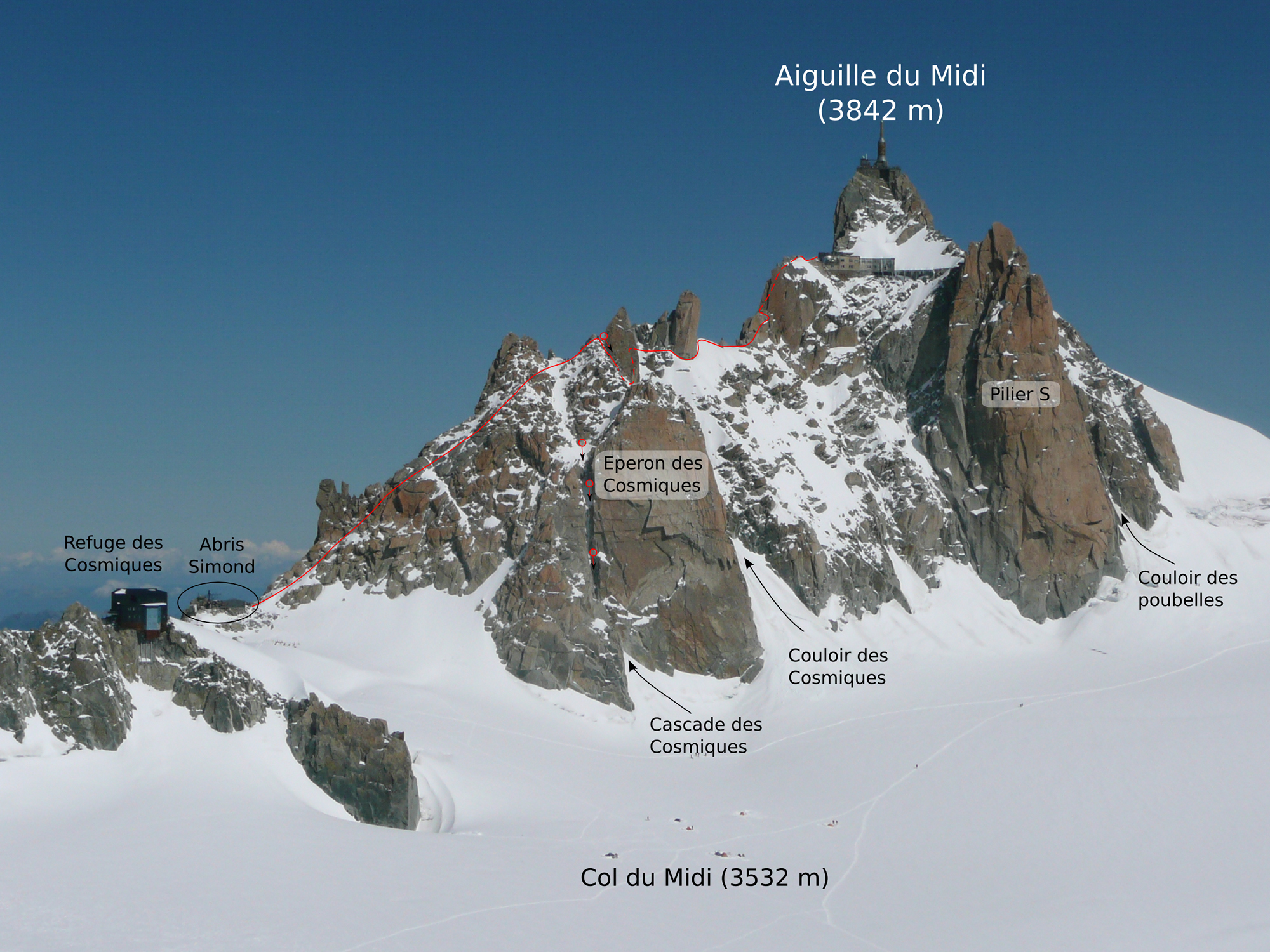
The weather was poor, with visibility down to about 15 meters, persistent snow and a reasonably strong wind which made walking across the galcier the scariest bit of the whole trip, especially when I put my foot partially in a small crevasse just below the Eperon - probably not big enough for me to fall in but it did make me think. I took some shelter behind the Abri Simmond, having a quick bite to eat before setting off.

I left the base at 10:10am (having left the Midi at 9:45/9:50am) and climbed fairly quickly up the first slabbly sectyion. The rock was very snowy and sections were covered in rime. After about 15/20 minutes I was at the first abseil. I though about down-climbing this as I've done several times before but as I needed to get the rope out for the next one decided it was probably quicker an safer to just rappel both. Rigging the second abseil my hands got quite cold having got wet earlier from brushing snow off holds, here I had a bit of a moment as once you do this you are fairly committed to finishing the rest of the ridge, including the crux slab. I went for it and got to the bottom of the gully where I pulled the ropes, here I made a stupid mistake. As I took my sack off to stow the rope I forgot that my axe was behind my back and dropped it and had to downclimb a good 15m to where it was perched precariously between two rocks, this cost me a good 5-10 minutes as I took it quite slowly. After this I soon reached the crux slab where I changed into dry gloves and then went for, the last section on the north side of the ridge went very quickly and by 11am I was slumped infront of the telescope on the viewing platform, 50 minutes after I started.


The guidebook time is 3 hours, so 50 minutes isn't bad, I'm happy with it considering the conditions. I would of really liked to of beaten John's record of 40 minutes, and I think if I did in good conditions I maybe could - but that will have to wait to next year. I really enjoyed doing it and got a huge buzz from moving freely and swiftly on the mountain however I really did feel alone and quite vulnerable if anything did happen (there were no other parties on the ridge), I imagine I'll do some more soloing, but I'm not quite sure how much yet.

Thats the summer alpine season over for me, I've done 7 weeks out in the Alps and got loads done, and in general the summer has been one of the best I've had for climbing with the month I spent climbing Yosemite, Squamish and Nevada before the Alps. Apparently its time to knuckle down and finish my degree now...

Wednesday, 22 September 2010

Vallee Blanche Acclimatization

Myself and Ash headed up the Midi lift on Sunday morning after arriving in Chamonix the evening before. We carried up bivi gear and dropped this off at shack that's perched on the spur of rock below the Cosmiques hut. This hut isn't officially acknowledged in any guidebooks or on any maps as far as I know, probably because if it was more well known the actual Cosmiques may loose some business! It seems to have fallen into a little bit of dis-repair recently as the top section of the door is now missing and one of the blankets has been nailed up to cover the hole in a crude fashion, due to this there was quite a bit of snow that had blown inside that we needed to clear. Thankfully it wasn't a windy night so we were ok. Theres probably enough wood lying about under the platform in their for somebody with a bit of skill to fix the door up a bit.

Anyhow after dumping our kit we had a lap on the Cosmiques Arete as Ash had never done it before. I think this was my 5th time on the ridge this summer, and I could probably climb it with my eyes closed now but it is still a good route. It gets a lot of stick of sites like UKC from people that its too busy, not that good and too accessible but I disagree with most of this. Yes there are hundreds of finer routes in the massif but this is one of few that provide what I consider to be a good standard of climbing in such a accessible location. Simply looking at it, less than about 16 hours after getting off a plane in Geneva we were at 3800m climbing, there aren't many places you can do that in the world!

The route wasn't too busy, but a combination of us not moving too fast due to coming straight from sea level and one or two incompetent parties on it meant we took about 3.5 hours which is pretty slow but we took our time, and Ash was able get to grips with the area and back into the whole alpine thing. A quick jog back down the snow arete and across the glacier to the shack and we made are beds an prepared the evenings food.

Pointe Lachanel.

The next days plan was to climb the Contamine-Mazeaud (central route) on the Tacul Traingle however due to the combination of neither of us sleeping particularly well during the night and the alarm not going off in the morning and us getting up late we decided on shorter day so went to go and do the traverse of Pointe Lachanal. The Pointe Lachanel is most famous for its east face which is home to some classic, albeit fairly challenging rock climbing. The three summits can be traversed though, this is given the grade of AD 4a and involves some steep snow slopes, ridges and some mixed ground with a about 60m of rock climbing at the end to the final summit. This was covered in quite a bit of snow an ice when we were there due to it being the end of the season so was in mixed condition, still not hard though probably only going at about Scottish II. Ash led the first section of the ridge until the middle summit where I took over and led up through the mixed section to the final summit. Another steep snow slope led down to below the Tacul Traingle. I actually really enjoyed the route, I'd dismissed it in the past due it being dwarfed by the bigger mountains and harder routes that surround however it was actually quite good fun, not something I'd rush back to do again soon but something I'll keep in mind for a short day or when the weather isn't too favorable. I imagine a good acclimatization day would be to do this and then the Cosmiques in a day.

I'll add some more photos when I get chance to get them off my camera, and get hold of Ash's.

Thursday, 26 August 2010

Black Diamond RPM 26 - Review

I've been using my Black Diamond RPM for most things over the last 6 weeks in Chamonix, from long rock routes to big norths faces, and its taken it all in its stride, and I'm super pleased with it. Here's BD's spiel on the pack:

'Designed for constant movement on big days, the lightweight RPM features a highly compressible, ergonomic design so it moves with you during climbs and scrambles.'

I've been thinking of buying a small lightweight pack for a while now, I toyed with purhasing with the Arcteryx Cierzo 18 or 35 for quite a time while climbing in the Rockies but was never convinced as the 18 seemed to small and featureless but the 37 was a bit too big. I saw the RPM in Snells and it looked liked it fitted somewhere in the middle, so went for it.

The RPM is essentially frameless, so don't expect to be carrying any loads in it. Its got a small waist strap effort which is effectively just their to keep it stable rather than transfer any load, this comes off really easily when you start climbing though. The back does have a thin layer of foam which gives some comfort and structure when packing. Enough of talk of carrying loads though, if your carrying big loads you don't want this rucksack! What this pack excels at is big days going fast and light in the mountains.

For lift accessed climbing, and staying in hut in the Alps this is perfect. I can quite happily fit water, food, a few layers and first aid kit plus whatever gear I need for the route. It compresses wonderfully as well, so you end up climbing with a snug small rucksack rather than something half empty and flapping around. The zip design is a little unusual, and a departure from my normal rucksack purchaing trend, I've always been of the school of thinking that zips can break and I'd always prefer a solid drawcord and buckles/lid. Zips are light though, this back weighs in at 600g, sure there probably not as durable as a standard system but I think I'm willing to sacrifice a shorter lifespan in this case. For such a small sack two ice axe loops on the front are also great.

Using the RPM alpine climbing in Chamonix.

The fabric seems to be relatively hard wearing, after 5 weeks of use in the alps theres only a few scuff marks and one small hole which was caused by hauling it up coarse Chamonix granite on the Rebuffet route. Its never going to last as long a old school alpine sack like my POD Black Ice or similar, but its a fraction of the price and the weight.

The downside is that I doubt I'll be pulling this pack out for much use in the UK, I could imagine the zip letting water through into the main body of the pack really easily and it probably the wrong kind of size for most mountaineering days, plus mines is white, which is certainly not the colour of choice for most moist, mossy or muddy british scrags. But if your looking to go lightweight in the Alpine regions this would be great, I could imagine this being a really good sack for long ice routes as well.

Theres a few other reviews floating around the web, one at Sierra Descents and one at the Colorado Mountain School.

Wednesday, 25 August 2010

Alpine Finale - Kuffner Ridge

I'm back in the UK, having spent Monday an Tuesday in Zurich flying back into Manchester yesterday afternoon. After a bout of bad weather over last weekend we set off, perhaps a little prematurely for a crack at the Kuffner/Frontier Ridge on Mont Maudit, a big classic mixed route at high altitude.
The Kuffner Ridge on Mont Maudit, D IV 850m.

We chose to do the ridge in whats probably its most classic form, to approach the Col de la Fourche bivi hut, which is perched very precariously on the arete which divides the Cirque Maudit and Brenva basin, then traverse the Tour Ronde-Maudit ridge to the base of the true Kuffner and then climb the 850m of height to the top from there. The alternative would be to leave from the Torino hut, pass under the Tour Ronde, the Col de la Fourche and head up a snow slope just as the ridge steepens.

We left the Midi in fair conditions, but these soon deteriorated. There had been a lot of fresh snow as well, so as soon as we left the tracks of the Vallee Blanche traverse path somewhere just below the Grand Capucin we were trail breaking all the way up Cirque Maudit. The approach climb to th bivi hut it about 200m, sitting somewhere around scottish I/II, so really easy but it was super hard work as there was a good 60cm of powder snow sitting on the route... 1 step forward two steps back kind of thing. We got to the hut just as the weather was beginning to worsen. We had a bit of dilemma as we knew that if we were to set off the next morning and struggle up the Kuffner, we'd basically be committing to Mont Blanc and down the Gouter route as the normal route down Tacul back to the Col du Midi would be an avalanche related death trap waiting to happen. We decided to bail, so set off back down the couloir the next morning, with only a 60m rope, 30m rappels interspersed with some down-climbing took a little time but we were at the bottom at a good time. The weather really came in on the walk back to the Midi with hight winds and wet snow making for near Scottish conditions.

Second pitch on the Voie Frison-Roche Route.

After our retreat on the Kuffner we decided to have an easier day so headed up to the Aiguille Rouge on the Brevent lift to do the classic Voie Frison-Roche, TD- 6a. The route was really good, and never that hard or desperate. Stubbsy had a bit of an issue on the 6a crux crack pitch an had to retreat but I soon got up it probably thanks to Yosemite crafted crack climbing skills. Its well equipped with good belays and fairly spaced bolts. We got the first lift but were at the top by 11am, 8 pitches I think. Petit Kitchen followed, naturally.

Myself on the classic snow-fin, just before l'Androsace.

So with two days left, the weather finally improved so we decided to go and redeem ourselves on the Kuffner. The approach was much easier, as we followed the trail we'd put in a few days before! We went to bed with clear skys and got up around 4am to fantastic frozen snow, clear skys but not baltic temperatures - perfect! The traverse along the first horizontal ridge takes a bit of time as there are two fairly sizable gendarmes to cross with several bit of down-climbing. After this you start the 850m of mixed ridge climbing which leads you to the top of Maudit, a series of snow gullies and ridges, mixed sections and the odd bit of rock climbing. The technical crux of the route is probably a short rock section of about 4c after the traverse under the point l'Androsance its easy though. The physiological crux is certainly the exposed corniced snow aretes in the top sections with are difficult if not impossible to protect. We hit the top at 10am, having taken 6 hours from the bivi hut, and 4.5 from the start of the route. Both under guidebook time so we were fairly happy. I was keen to push on for Mont Blanc as it really did seem so close but Stubbsy was suffering quite a bit so we quickly dropped down to the Col Maudit, over Tacul and then the slog back up to the midi station. By 2:30pn we were sat in the Petit Kitchen with bacon an sausage sandwiches. Absolutely fantastic route, one of the best I've done.

Stubbs on one of the final snow ridges.

Theres a lot more photos of the route in my facebook photo album.

So thats it for my summer alpine season this year, its been a good one and I've got lots done, but the Kuffner was certainly the high point and a perfect finale. Our tour de force of the Chere Couloir and North Face of the Tour Ronde in two days was pretty satisfying as well. I need to focus on my dissertation for a week or so now, but my had is still in climbing mode...

Thursday, 12 August 2010

Sunny South-face Rockclimbing & Cold Icy North Faces

So another update on alpine happening out here in Chamonix, I'll start with a bit of an update of conditions.

With the end of the hot period a few weeks ago a lot of snow then fell around 1-2 weeks ago which put all the snow, ice an mixed routes into good, or at least better condition then they were, we took advantage of this in a few weather windows over the last few days. The weather has now taken a turn for the worse now, with the forecast being fairly unsettled for the next few days. It feels a bit as if we've been juxtaposing types of routes over the last few days, being on warm sunny south faces oen day, in t-shirts and rock shoes and then on cold, icy north face routes the next!
Stubbs arrived just over a week ago, so the day he got here we just headed up for a quick lap on the Cosmiques arete in the afternoon to get our heads in the game for climbing together. We did it in 1 hour 40 mins which wasen't as quick as me an Chris did it a few weeks before that but was still fairly rapid considering we had a bit more queuing to do. You can tell its the high season here as there was a line of about 20 people at the crux slab! Thankfully we maanged to bypass most of these.
Stubb's seconding one of the easier pitches on Indianna Jaune!

Last Saturday, we headed out with a local; Brian Birtle, to a big limestone sport cliff down towards Sallanches. I'm not really a sport, well not really an udnerstatement, I'm not a sport climber! But Brian had the day off an was looking for people to climb with so we thought we'd go along an have a go. We went and did 'Indianna Jaune' on Maladiere, its 300m in 9 pitches and goes at 6c+. Its fairly sustained with about 5 of the pitches being in the 6b range, and the rest not being much easier. Its also fairly commiting, not in a dangerous sense, just due to the fact to get to it you walk up to the top of the cliff and then embark on 5 abseils to get to the bottom, leaving your shoes an stuff at the top! The cliff is huge, and very very steep, as a lot of abseils leave you haning in space away from the wall. The route doesn't waste anytime either with the second pitch being the 6b+ crux, now I've led 6b sport before but this felt a lot harder than that - I have to confess I pulled on a lot of quickdraws and ropes to get through it. The exposure on the wall is fantastic, Indianna Jaune takes the easiest line on the face, the rest of the routes are a lot harder so your alwasy climbing in between very very steep, and very very blank rock. We averaged around 40 minutes a pitch and got to the top at around 7pm, before a hurried descent and drive to the kebab house in Cleuse. Big respect to Brian for dragging us up all the hard bits, and the the route in general! Absolutely superb.

At the bivi for the Rochefort Arete.

Early last week we headed up with a friend of Chris's, Remi whos been living in the UK for a while. We took an afternoon lift up the midi and traversed the Vallee Blanche in fiarly bad conditions to get to a bivy spot above the Torino hut for an attempt on the Rochefort arete the day after. We went fairly lighweight for the bivy, and were a little cold after the clouds dissapeared, and quite relieived to get moving at 4am. The route starts with a slog the glacier, over the bergschrund and then a small, but shallow mixed coulir lead to the col. Here we ditched crampons for the scramble up to the Salle e Manger below the Dent du Geant. The scramble cover around 300m of height and some fairly loose chossy ground, so it was nice to be on it when it was all fairly frozen together. We reached the start of the Rochefort Arete at around 8am. Remi wasen't feeling too good due to the altitude and to add to this Stubbsy had lost his glacier glasses on the ascent so was struggling to see as the sun began to break over the horizon. So a little frustrated we turned around, it was a shame, as I could see the whole arete stretching out in front and it looked ace, and so close! We were glad to be descending the chossy ground while it was still frozen though, there were a few parties on their way up as we were descending and they were starting to knock a lot of stuff down. Two short abseils and a bimble down the glacier and we were back at the bivi spot, before making out way back to the Midi.

Friday/Saturday we decided to take advantage of a good weather window and head off to try an do a route first on the Tacul Traingle, then cross the Vallee Blache, sleep at the Torino hut and knock out the North Face of the Tour Rone the next day before heading back. For some reason the first Midi lift was delayed and it was after 8am when we were leaving the station. There were 3 teams (of which 5 of the 6 people, ourselves included were sporting our new minimalist alpine rucksacks! - I'll be reviewing it soon on here as its ace) heading for the Chere Couloir, our chosen route. The routes given D, which is really soft for the standard of climbing but due to its accesibility of being an hour from the lift station is fair. Its about 250m of ice climbing, with the crux pitches being 85 degrees, so about WI4. We moved together up the first pitch and then did 5 fairly full pitches before abseiling back down. The route was in good condition, with good ice on the steeper bits and bomber neve on the more easy angles slopes. We chose to abseil back down the route in 5 abseils to below the bergschrund rather then continue up to Tacul and secend the normal route through the seracs which with all the new snow would of been pretty dodgy.

Myself leading one of the easier upper pitches on the Chere, lots of spindrift!


After we were down we roped up and began the crossing to the Torino hut, getting there a few hours before dinner, and then having a fairly early night.


The North Face of the Tour Ronde, our route took the lower and upper icefields linked by the snow gully in the middle.

We left the hut at 5:30am, which was probably a little late as depsite being a north face, the route on the tour ronde gets the sun fairly early. The North Face route is 350-400m, moving first up a icefield directly above the bergscrund and then through a snow gully which leads to the upper icefield and the summit. The climbing is much easier than the Chere, being at the steepest maybe 55/60 degrees - the crus pitches are in the gully. We moved together up the first icefield for around 100m with myself leading, and then pitched it through the gully and up the summit icefield getting to the top by about 2pm. We moved fairly slowly but this was due to the fact we were fairly tired from the previous day. The descent was tedious as we first followed the PD rock ridge before dropping off at the shoulder on the the Tour Ronde Normal Route, which is AD and follows a broad, and very loose couloirs. 3 Abseils got us to the bottom of this, and then a sprint back to the lift station.

We fancied a bit of warm rock climbing for change after our cold north face endeavours so headed up the Flegere lift and then the index chair to climb on the index, a huge fin of rock standing clean away from the mountain. The classic route takes the ridge up this, at about 4c but we opted for a link of two routes on the face, going at about 5c/6a over 7 pitches. The climbing was nice, and most of the pitches were pretty well equipped. We abseiled off the summit, back down tot he chair and were back in Chamonix for late afternoon.


Stubbs atop the Aiguillete de Argentierre.

Continuing the theme of sunny rock climbing, after a fiarly heavy night with Chris, John a Scott we got up late so drove up towards Argentierre and walked up to the Aiguillete de'Argentierre, a small pinnacle about an hour from the road road. This was pretty easy, if a little dissapointing with two pitches of maybe 4c getting us to the top. Nice views from the top of the pinncale though. After this we did a route on the cliff opposite, which was 4 pitches of 5c, excellent slabby climbing on warm Schist.

Yesterday we headed back up into the big mountains to have a look at the Rebuffet Route on the Eperon des Cosmiques. Me an Chris went and had a look at this a few weeks but decided the start was out of condition and dangerous due to the snowmelt. We'd heard about a direct start though, that missed this though so decided to go an have a look. The catch was that apparently it went at about E1. The crux of any alpine rock route was as always getting out of crampons and boots, getting these into your rucksack and then getting your rock shoes on! I led off up the first pitch we'd been informed about and immeidietely found it quite hard so left my sack on a runner for Stubbs to deal with later. The climbing was awkward but got easier and eventually I made the belay an then brought Stubbs up, who was complaing about having to come up it with two sacks. I'm not sure it was E1, maybe hard HVS, but still fairly hard on a mountain. I then led out the rest of the rightwards trending ledge system, belaying below overhang pitch. Stubbs came up and I set off up the overhang pitch, this starts with some lovely crack climbing with good gear before you reach a big roof which sticks out about 2m. You can free this, but it goes at about VI so I just pulled on the gear an got through it quickly. 3 More pitches on lovely orange granite cracks led us to the top of the buttress at about VS, and then we zoomed along the Cosmiques Arete, getting to the station for 2pm. Superb route.


Me, leading on the Cosmiques crux slab.

We've had a rest day today, as the weather is bad, its actually looking quite unsettled for the rest of the week so we'll what we get done. I'd like to do the Frendo or Kuffner, and Chris is talking about the Brenva but there all fairly serous routes, so we'll be needing a spell of settled weather to get on any of them.

In addition to the above we've also beein hitting the valley crags like les Gaillards quite a but in between things.

Friday, 30 July 2010

Chamonix So Far...

I've been in Chamonix just over a week now, the weather has been a little intermittant and windows have been short but I've still managed to get quite a bit done, while still having a fairly relaxing time.

Last Thursday me an Chris went up and did a quick lap on the Cosmiques from the first bin, our original plan was to climb the Eperon des Cosmiques roiute which is about 8 pitches up one of the buttresses on the south face of the midi. Unfortunately due to the recent warm temperatures the approach gully had melted out leaving a lot of very precairous looking loose rock, so we bailed and legged it down to the bottom of the Cosmiques Arete which we in 1.5hrs from bottom to top, soloing up to the crux slab where we roped up. We got the sad news as we topped out at the lift station that Dave Ridout, a very prominant figure in both our scouting backgrounds had passed away that morning. While sad, it was quite a fitting place for us to receive the news, and I'm sure he would of agreed. RIP Dave.

I've done a bit of sport cragging at the crag thats about 10 minutes walk from Chris an Andrea's place, for a local crag its pretty good, with routes up to about 3 pitches. I did l'Arete with Heather one afternoon which was a nice route at about 5c.

Over the weekend I went for a big walk, for some fitness training, and due to the fact I was short of a partner for climbing. Up from Les Pelerins to the Plan station and then a lovely traverse along underneath the Chamonix Aiguilles at about 2400m, before dropping down to the Montenvers station and walking back down to the valley.

Me leading, about 8 pitches up the Chappelle route, just before the South Shoulder.

Tuesday I got out with a friend of Heather's, Mike who's Swedish. We headed up the Flegere cable car and then the Index chair on the Aiguille Rouge on the other side of the valley first and headed for the classic Chappelle route on La Gliere. The route is 14 pitches with most in the 4c-5b range, apart from the final pitch which is 6a, but probably a soft 6a at that. Its partly equipped meaning that most of the belays are bolted, and theres pegs here and there on the route where you most need them. We managed to do it in just over 4 hours from bottom to top which for 14 pitches I was pretty happy with considering we'd never climbed together. We had a awesome view of the massif over the top of the cloud inversion all day, Mont Blanc, Aig Verte, Grande Jorrasse etc. - getting very inspired for the next few weeks.


Climbing the 'Razor Edge' pitch on the Chappelle route. Mont Blanc in the Background.

Wednesday me an Chris took the first bin up the Aigille Midi to do the Midi - Plan traverse. I had it in my head that it was going to be a bit of scary walk, which was probably underestimating it as it gets AD in the guide. It starts off following a series of narrow snow ridges that extend from the one that extends down from th lift station. Eventually you reach a rock buttress whcih you pass on the Chamonix side, the climbing its probably Scottish I/II but it pretty exposed and you woulden't want to fall. Another bit of a snow plod leads to an easy mixed couloir and then the rock ridge which calls for a bit of concentration with some more exposed moves. From the end of the ridge 3 abseils get you down to the glacier again where you head up to the plan. You can return to the midi station the way you came but we decided to decend the Requin glacier down to the Requin hut on the Mer de Glace and out to the Montenvers train station. The Mer de Glace was a little tedious with a bit of zig zaggin having to be done through the crevasses below the Envers de Aiguille, we were glad on a ice cream and coke when we got to the station.

Yesterday the weather was pretty bad so I had a bit of rest day, going to the Petit Kitchen for lunch, and then some browsing round Chamonix. I'm about to head out to Gaillands with Mike today for some rock climbing, and hoping to get up on the Chamonix Aiguiiles from the Plan lift tomarrow with Brian, but we'll see as the snow line is down to 2400ish at the moment. Unfortunately the Frendo is out of condition with rock getting covered in snow from time to time with these storms and more importantly the ice at the top being in really bad condition, I'm still optimistic that it might come back in but realitically it might be next year before I get it done, I'm begining to think spring may be a better time for the mixed routes...

Sunday, 28 February 2010

Summer Alpine Clothing - Soft Shell Pants

After my return from Canada, and once I get my practical work done for my dissertation I'm planning on spending some time in the Alps with various people this summer, hopefully ticking some of Rebuffet's classic routes in the Mont Blanc massif. Joining me for the first period of the trip is my friend Lewis Abbott, we had a conversation recently and he asked what I thought regards soft shell pants for summer alpine climbing so I thought I'd spill some of my thoughts on the topic on here.

So whats the definition of soft shell, in my mind its something that is much more comfortable to wear than a full hardshell (Gore-tex, eVent etc.) due to better breathability and less restricted movement, the downside being that they don't offer the full weather protection of a proper shell.

The soft shell concept has been around for a lot longer than people think, perhaps not in its current guise of sexy stretchy fabrics that have been popular for the last five years, the original soft shell was the combination of pile and pertex by Buffalo in their smocks, and similar things from companies such as Montane and Mardale. Shortly after this shelled-micro-pile became very popular, with the most famous incarnation being Marmot's Driclime fabrics. These consist of a windproof and water resistance outer fabric with a high wicking linear hung inside and are in my opinon one of the best options for a soft shell options out there, Rab popularized this design even further with the introduction of their Vapourise line which works on the same concept.

Sporting a Montane Pile/Pertex Extreme Smock, where it belongs, in Scottish Winter.

If we step away from the above and look at the types of fabrics that most people at present would consider stereotypically 'soft-shell', soft to touch stretchy fabrics they can be roughly divided into two categories, those built with a membrane and those without. Membrance fabrics such as Windstopper, eVent softshell and other all other a lot of protection but often offer little advantage in breathability over a conventional waterproof. Fabrics without a membrane are usually a lot more breathable but don't offer the same level as protection.

So how does all this crap relate to what to wear on your legs in the Alps, wells lets look at what you want a pair of pants to do. Full on waterproof salopettes like we'd traditionally see being worn in the depths of scottish winter are overkill for the alps, you'll get far too hot so breathability is key. You want them to have a degree of weather resistance, to be windproof to a degree, be able to shrug of snow and maybe some light rain as when you've got your harness on (which 90% of the time you will have) you won't be putting your over-trousers on that easily. Alpine climbing is hard on your clothing, particularity on the knees and ankle cuffs so you want them to hard wearing, reinforcement in these areas is a good idea. Finally your going to be wearing these pants for climbing so you want them to have good movement, this can be through stretch or just pants that are cut really well.

So what are good options that are out there?

I personally prefer a softshell pant without a really heavy membrane, and am quite happy to sacrafice some of this protection for breathability. I own a pair of membrane pants, Mountain Equipment G2 Ultimate Mountain pant and they are good pants but I find there uses limited, and generally not suited to summer alpine climbing (I use mine for Scottish Winter and cascade ice climbing where the temperatures are cold and its often wet, many people don't realize it but the wind-stopper fabric by Gore is effectively waterproof).

The two pairs of softshell pants that I've owned that I've found have worked particularly well in the alpine arena are the well known Patagonia Guide Pant and the much more elusive Montura Vertigo Light Pant. The guide pant has been around for years, and theres been a few different incarnations but in general the design has stayed roughly the same. They use a stretch woven fabric which gives a good freedom of movement and is DWR treated, if you look after this, washing it and re-activating it regularly it will keep beading water and shrug off snow without a problem. One feature I liked in the pair that I owned, circa 2006/7, was the gathered ankles which had a nice burly piece of hard wearing material on the inside to protect them from errant crampon spikes or sharp ski edges, they also had a zip though which meant you could still get them over bigger boots, and another good feature were two webbing loops on either side which allowed you to fit a piece of elastic you put under you boot, reducing the need for gaiters. I found the pants very hard wearing, despite them actually not having the reinforcements I mentioned originally, they did a lot of miles of rock routes, scrambles and actual alpine stuff and if they still fitted me I's still be wearing them now. From a UK perspective they're actually pretty dam useful once you get back from your trip to the alps as due to the breathability, and weather resistance there the perfect pants the UK hills in spring and autumn, and for some aspects of winter.

Wearing the Guide Pants in the Jostedal, Norway.

So lets move on and talk about the second pair I mentioned, Montura Vertigo Light Pants. I'm guessing that a large proportion of the people reading this won't of heard of the brand Montura, and until a few years ago I hadn't either. Its an Italian company and from what I can see there are very few places outside of Italy that you can purchase their stuff, the shops of Cortina of full of it, and I think Cham3s in Chamonix, France stocks some. I picked mine up from Matterhorn Sports in Zermatt, Switzerland in 2008. Simply put, there amazing, the best alpine pant I could want. The cut of the pants is fantastic, its very tight and athletic so may not suit everyone, think technical ronhills and you won't be far off. The ankle cuffs and lower leg are particularly close fitting and form a nice seal at the top of your boots stopping snow from getting in, due to this theres no excess fabric flapping about to catch on your spikes either. The next box in my list of things an alpine pant should do is that there hard wearing, the seat, knees and inside legs are all made with a Kevlar weave material which is incredibly tough, I've worn mine on Skye, Scotland and for anybody thats climbed on the Gabbro there this is a definite testament to them. So this leaves us with breathability and weather resitance to deal with, and the designers of these pants tackled this really well. The front of the pants are constructed of a stretchy, fairly waterproof ripstop material whereas the backside is made of a simple stretch woven material that is much more breathable. Climbing pitches of ice, or steep snow sections its the front parts of your legs that are going to need the protection, these pants give that but allow you to dump heat out the back at the same time - its a great idea.

Vertigo Lights in action on the Nadlegrat Ridge, Valais Alps, Switzerland.

So that my two cents, there are a lot of other pants out there that I've not had personal experience with, when I wear out my current pair I'd be keen to try out Arcteryx's Gamma AR Pant, and Mountain Equipment's Liskamm Pant also looks like a good contender.