Due to me having classes until 12, us spending copious amounts of money on KFC, and Struggles generally being incompetent myself and Lewis got out the car on Friday in Langdale a little later than expected, at nearly 4pm. The sun had already set.
We headed up stickle gill first, which was starting to freeze up quite nicely, some parts of the path were a little precarious with 1-2 inch ice covering portions. We did a lap of the Pikes, which were a little wintery before heading over to Stake Pass. The aim of the night was to practice some night navigation, which we did after walking round in circles for a while trying to the tarn, which was eventually we did. Once there we stopped for some tea (around d 8/9pm) and devoured our KFC provided hill food, but then got very cold very quickly, it was probably around -5C so moved on. Some more bearing work got us to across to Angle Tarn, where we headed up towards Allen Crags. The whole East side of the Scafell Massif was fairly white, and the sky was clear with a bright moon which made an awesome atmosphere. We then re-traced our steps and headed down Rossett Gill (which is also freezing in places), this was again pretty tedious with the paths covered in ice in places. We got back to the car around 1/2am I think.
We took quite a few videos during the day/night so when I get chance I'll edit them together and put them up here.
Monday, 29 November 2010

Sunday, 28 November 2010
Howgill Fells
Monday, myself and Lewis headed up to the Howgills, a group of hills bordered by the Lake District to the west and Yorkshire Dales to the east, and that get comparatively little attention - which is a good thing as we saw nobody all day. While perhaps not as rocky as hills in the Lakes, these are still big hills, and the solace is a nice change from being in Langdale or Coniston, plus it only took us 30-40 minutes to get there from Lancaster.

We parked at Cross Keys (SD 698 969) which is one of the best access points and headed up via Cautley Spout, which I fancied a look at as during particualary hard winter it freezes making an awesome ice route. From their we headed up the tops, doing a circuit of Great Dummacks, Calders and the Calf. We looked at a few different navigation techniques along the way in preparation for Lewis' upcoming assessment, the clag was down which provided some good, realistic conditions. We had a late lunch by the trig point on the Calf and then headed down just as it was going dark.

We parked at Cross Keys (SD 698 969) which is one of the best access points and headed up via Cautley Spout, which I fancied a look at as during particualary hard winter it freezes making an awesome ice route. From their we headed up the tops, doing a circuit of Great Dummacks, Calders and the Calf. We looked at a few different navigation techniques along the way in preparation for Lewis' upcoming assessment, the clag was down which provided some good, realistic conditions. We had a late lunch by the trig point on the Calf and then headed down just as it was going dark.
Monday, 15 November 2010
Kendal Mountain Film Festival
Its the annual Kendal Mountain Film Festival this weekend. So far I've booked to see the world premiere of 'The Pinnacle' which documents Dave Macleod and Andy Turner repeating the Smith - Marshall famous week climbing on the Ben last winter, which should inspire me a bit for our CIC weekend in March! I've also got tickets to the Snowsports evening on the Friday, theres a few ski films being shown, and Glen Plake is there so that should be pretty cool as he is THE guy from Blizzard of Aaahhhs.
The trailer for the event as a whole is below:
The trailer for the event as a whole is below:
Tuesday, 2 November 2010
The Fun Scale
A friend of mine that I used to climb with in Canada first introduced me to the Fun Scale, having read about it in the Canadian Alpine Journal. I've done a bit of googling and it seems that its an idea thats been mooted around mountaineering circles for sometime. What it's basic function is, is to divide 'fun' up into three discrete categories each of which can be applied to experiences in the mountains, and to some extent real life. I'll give a bit of a basic description below of what I perceive each type to be and include:
Type I
Things you actually enjoy when they are happening, and perhaps the purest form of fun.
Roadside iceclimbing. Good food. Sunny south facing rockclimbing. Beer. Lift accessed Chamonix-stlye alpinism (when everything goes to plan). Good sex. Powder skiing. Gear shopping. Scrambling.
Type I fun rarely leaves you with any real significant memories though, you may think back that you enjoyed the day, but you didn't really have to graft for anything. Ultimately I find it to not be quite as satisfying as it could be.
Type II
Fun in retrospect, can be anything from unpleasant to downright hateful in doing, but given a un-specified amount of time you look back on it as a good time.
All other alpine climbing. Scottish winter. Going rockclimbing in the UK in the bad weather 'to make the most of the day'. Pretty much any day I spend in the mountains with Carl Stubbs. Dropping one tool on a route. Going hillwalking.
 Martin Freeman getting the fear on, and hence having some good old Type II on Viking Buttress IV 4.
Type III
Not really fun at all, things that were certainly a bad idea, and you'll probably never do again.
Near death experiences. Loose rock. Dropping both tools on a route. 9am Lectures. Getting avalanched.
This is probably my least favorite of the three types, and thankfully I've only experienced it once or twice. Type II events often have the potential to become Type III if things don't go your way.
 Martin Freeman high on Via Alvera, V+, Averau.
Type I
Things you actually enjoy when they are happening, and perhaps the purest form of fun.
Roadside iceclimbing. Good food. Sunny south facing rockclimbing. Beer. Lift accessed Chamonix-stlye alpinism (when everything goes to plan). Good sex. Powder skiing. Gear shopping. Scrambling.
Type I fun rarely leaves you with any real significant memories though, you may think back that you enjoyed the day, but you didn't really have to graft for anything. Ultimately I find it to not be quite as satisfying as it could be.
Type II
Fun in retrospect, can be anything from unpleasant to downright hateful in doing, but given a un-specified amount of time you look back on it as a good time.
All other alpine climbing. Scottish winter. Going rockclimbing in the UK in the bad weather 'to make the most of the day'. Pretty much any day I spend in the mountains with Carl Stubbs. Dropping one tool on a route. Going hillwalking.
 Martin Freeman getting the fear on, and hence having some good old Type II on Viking Buttress IV 4.
Type II days are perhaps the best, usually being a lot for satisfying in the long run that type I. There good character building and you quite often come out of them having learnt things.
Carl Stubbs after a retreat from the Col de Fourche bivi hut in bad weather.
The video above shows Stubbsy after we'd descended the 200m couloir that leads up to the Col de Fourche above the Cirque Maudit in Mont Blanc Massif. We'd intended to do the Kuffner Ridge but got screwed over a little by Chamonix Meteo with warm temperatures and lots of new snow. If we'd of gone for the route we'd of taken a long time on it, and probably been committing to going over the Blanc in a storm as neither of us wanted to descend the Tacul normal route, so we bailed abseiling down the couloir which was wet and loose in 25/30m sections as we only had one rope. The last one left us a good 5m short of getting over the bergschrund - definite type II territory for both of us there. After a few tedious hours crossing the Valle Blanche to get back to the Midi in a white-out we were down in town, eating lunch in the Petit Kitchen thinking that actually it was all pretty good fun, and we'd probably go for another crack in a day or two.
Carl Stubbs after a retreat from the Col de Fourche bivi hut in bad weather.
The video above shows Stubbsy after we'd descended the 200m couloir that leads up to the Col de Fourche above the Cirque Maudit in Mont Blanc Massif. We'd intended to do the Kuffner Ridge but got screwed over a little by Chamonix Meteo with warm temperatures and lots of new snow. If we'd of gone for the route we'd of taken a long time on it, and probably been committing to going over the Blanc in a storm as neither of us wanted to descend the Tacul normal route, so we bailed abseiling down the couloir which was wet and loose in 25/30m sections as we only had one rope. The last one left us a good 5m short of getting over the bergschrund - definite type II territory for both of us there. After a few tedious hours crossing the Valle Blanche to get back to the Midi in a white-out we were down in town, eating lunch in the Petit Kitchen thinking that actually it was all pretty good fun, and we'd probably go for another crack in a day or two.
Type III
Not really fun at all, things that were certainly a bad idea, and you'll probably never do again.
Near death experiences. Loose rock. Dropping both tools on a route. 9am Lectures. Getting avalanched.
This is probably my least favorite of the three types, and thankfully I've only experienced it once or twice. Type II events often have the potential to become Type III if things don't go your way.
 Martin Freeman high on Via Alvera, V+, Averau.
Two summers ago Martin and I climbed a big rock route on the south face on Mt. Averau in the Italian Dolomites. The day didn't start well as two rocks came flying down while we were gearing up at the bottom. It progressively got worse, with each pitch and belay becoming less and less well protected and even looser. The in-situ belays that the guidebook referred to were often missing or very poor state. The climbing was never super hard, just super scary. We were both pretty relieved to get to the top, and made the decision that we'd probably never do this route again. Ever. I can look back on this now, and while there were limited sections that were perhaps Type II (the scary traverse) the Type III elements far outweighed these.
Thoughts?
Thoughts?
Monday, 1 November 2010
Troutdale & Gillercombe
This weekend I was in the Lake District with the university mountaineering club (LUMC) for our first term fresher's weekend away. As usual the forecast was grim (although not as grim as 2 years ago when it coincided with 'Borrowdale storm' and OMM fiasco) but most of us got some stuff done.
 Jade & Veronica on quite a moist belay on Troutdale Pinnacle.
Saturday a group of us headed up to Black Crag and set off up Troutdale Pinnacle S 4a. I've done the route before, its another classic rock number and its really good with some varied climbing and being moderately long. The guidebook gives it 105m in 6 pitches, we managed it in 4, running 1+2 and 3+4 together. You could try stringing 5+6 together but unless you were very minimalistic on gear placements, and hence leave you second un-protected on to a degree on the slab down-climb at the start of pitch 5 you'd end up with quite a bit of drag, plus you'd miss the wonderfully exposed belay on the saddle by the pinnacle. The hardest pitches in my opinion are the final two, with the crux probably being one of the last moves on the last pitch but the gear it good and once you've got the hold its all good.
Foolishly I was being optimistic and set off without waterproofs on, only to have the torrential rain start at the first belay, pretty moist by the top. I also climbed the first 2/4 pitches in my Guide Tennies which seemed to work ok on wet rock, they were however, as always deadly walking down the grass on the descent. I had Jade and Veronica with me and I think they both enjoyed it.
Sunday we headed over to Gillercombe Buttress with quite a large group. With the forecast looking better I'd hoped, perhaps naively, that the rock would be dry - it wasn't, not in the slightest. I set off up Gillercombe Buttress S 4a with Jade and Rebecca in tow and Dan, Luke & Becca following us while another two parties set off us Grey Knots Face, the Diff slightely to the right.
 Pitch 2(?) on Gillercombe.
I did the route a few years ago on a lovely dry sunny day, but like everything it takes on a little bit of a different demeanor when its wet. The rising traverse on pitch 2/3 was interesting as was the crux slab on pitch 5 which was dripping, and which I almost slipped off completely - managing to grab a placed nut on my way down. The route is 195m and I think we did it in 5 pitches, we could of don it in 4 but I belayed before the traverse instead of after so ended up with a short 10m pitch over this, otherwise we just tried to run the rope out as there are belays a plenty. Jade and Rebecca did an awesome job of seconding in the poor conditions, climbing quickly and being spot on sorting stuff at the belays.
 Rebecca, Jade & Myslef at the top of Gillercombe Buttress.
After we topped out, we hung around for a while, looked around for the other but saw no sign of them and then bimbled down after we started to get cold getting to the bus at about 4:30pm, where sat around eating chorizo, cheese and cracker sandwiches, drinking whiskey and taking photos. Unbeknown to us the other parties had ended up in various predicaments forcing them to retreat, which in turn caused some issues of ropes getting stuck etc. I was just putting my boots back on at 7pm when a trail of torch lights appeared much to my relief, everybody was fine despite a few learning experiences and they all did really well to get off safely in the dark, the only casualty being a few club slings and biners, which are certainly expendable.
Bit of a learning experience for some people I think, a few key points being:
 Jade & Veronica on quite a moist belay on Troutdale Pinnacle.
Saturday a group of us headed up to Black Crag and set off up Troutdale Pinnacle S 4a. I've done the route before, its another classic rock number and its really good with some varied climbing and being moderately long. The guidebook gives it 105m in 6 pitches, we managed it in 4, running 1+2 and 3+4 together. You could try stringing 5+6 together but unless you were very minimalistic on gear placements, and hence leave you second un-protected on to a degree on the slab down-climb at the start of pitch 5 you'd end up with quite a bit of drag, plus you'd miss the wonderfully exposed belay on the saddle by the pinnacle. The hardest pitches in my opinion are the final two, with the crux probably being one of the last moves on the last pitch but the gear it good and once you've got the hold its all good.
Foolishly I was being optimistic and set off without waterproofs on, only to have the torrential rain start at the first belay, pretty moist by the top. I also climbed the first 2/4 pitches in my Guide Tennies which seemed to work ok on wet rock, they were however, as always deadly walking down the grass on the descent. I had Jade and Veronica with me and I think they both enjoyed it.
Sunday we headed over to Gillercombe Buttress with quite a large group. With the forecast looking better I'd hoped, perhaps naively, that the rock would be dry - it wasn't, not in the slightest. I set off up Gillercombe Buttress S 4a with Jade and Rebecca in tow and Dan, Luke & Becca following us while another two parties set off us Grey Knots Face, the Diff slightely to the right.
 Pitch 2(?) on Gillercombe.
I did the route a few years ago on a lovely dry sunny day, but like everything it takes on a little bit of a different demeanor when its wet. The rising traverse on pitch 2/3 was interesting as was the crux slab on pitch 5 which was dripping, and which I almost slipped off completely - managing to grab a placed nut on my way down. The route is 195m and I think we did it in 5 pitches, we could of don it in 4 but I belayed before the traverse instead of after so ended up with a short 10m pitch over this, otherwise we just tried to run the rope out as there are belays a plenty. Jade and Rebecca did an awesome job of seconding in the poor conditions, climbing quickly and being spot on sorting stuff at the belays.
 Rebecca, Jade & Myslef at the top of Gillercombe Buttress.
After we topped out, we hung around for a while, looked around for the other but saw no sign of them and then bimbled down after we started to get cold getting to the bus at about 4:30pm, where sat around eating chorizo, cheese and cracker sandwiches, drinking whiskey and taking photos. Unbeknown to us the other parties had ended up in various predicaments forcing them to retreat, which in turn caused some issues of ropes getting stuck etc. I was just putting my boots back on at 7pm when a trail of torch lights appeared much to my relief, everybody was fine despite a few learning experiences and they all did really well to get off safely in the dark, the only casualty being a few club slings and biners, which are certainly expendable.
Bit of a learning experience for some people I think, a few key points being:
- Don't underestimate a big mountain route in poor conditions.
- Climbing in a three can be slow, especially if your climbing in series and/or switching the leads.
- Its a pretty good idea to always have a headtorch, whistle, map an compass with you.
- A few meters of 6mm cord, or nylon tape in the bottom of your sack will avoid you having to leave slings behind.
- Everybody should really have at the minimum a single prussic with them for abseiling with.
Thursday, 28 October 2010
Snowdonia
Friday, myself and Julie headed down to the Ogwen valley, Snowdonia to get in a day in for ourselves before the event we were helping on over the weekend. As the forecast was fairly grim we decided up a itinerary I've done a few times before, a link up of the Ordinary Route D on the slabs and then Cneifion Arete D/3s. Cneifion Arete is a superb route in its own right, and can be approached in several ways; Sub-Cneifion Arete, the direct approach approach to Senior's Ridge or, and what I think is the most aesthetic is to do a route on the Idwal slabs.
 Base of the Idwal Slabs, in the rain.
We managed to do the Ordinary Route in two full 60m pitches and then a bit, the guidebook reckons it should take 4 - but its a straight line so if you've got long ropes just run them together. In the past I've moved up the route route together, climbing alpine style however with the wet weather today wasn't a day for that. From the top we stayed roped together and moved up the lower ledges of seniors ridge before dropping out into the Nameless Cwm.
Cneifion Arete is for my money, perhaps the best scramble in Wales, and its pretty full on as a scramble with the first pitch certainly warranting Diff. After this it eases off considerably as you follow the exposed razor edge to the top, which always come too early. We short pitched the first section and then moved together for the rest, the wind did pick up as we reached the crest though and we took quite a buffeting. The top of the Arete puts you somewhere along the Gribbin Ridge, as we were quite wet and it was late in the day, we bailed from here heading down the Gribbin and back into Cwm Idwal. In the past though I've continued up the Gribbin to the summit of Glyder Fach, or more interestingly dropped down to the main face of Glyder Fach and done the Dolmen Ridge which is another awesome scramble, right at that boundary between climbing and scrambling. I think these sorts of days are great training for alpine climbing, staying roped up all day and trying move nice and efficiently.
 Dave J & Tracey on the Arete, a few years ago.
Saturday we had a group from Ormskirk Explorers and Network with us, as the weather was again bad we went walking. The Explorers and Network all walked independently which was great as they all had to pitch in and do their share of navigation in some fairly bad conditions. the started up the PYG track from Pen Y Pass, summited Snowdon before heading off down the Ranger path to the col before heading up Moel Cynghorion and dropping down to our hut where we were staying. One group missed the Ranger path, but realized their mistake and corrected themselves but not before I'd blitzed it down the Llanberis path looking for them, then having to climb back up to Bwlch Cwm Brwynog from the half way station. Anyhow, they all did really well and despite the conditions seemed to have fun.
 Explorers & Network coming off Snowdon.
Sunday's forecast was much better, so we packed up and headed round to Ogwen for a mass trespass on Tryfan. We split into three groups, with Julie and Andy taking one each and myself the third. My team headed up Millstone Gully Aproach which is given grade 2 before doing Millstone Continuation Grade 3 which we short pitched. We then followed an interesting line up the North Ridge with the group taking the lead through some challenging sections. We all ended up on the summit at the same time which was great, before heading down to the Tryfan-Glyder Fach col and back to the car.
 The ONMAS group on the summit of Tryfan.
I think the weekend was a great success, even if we did make a financial loss, we certainly be running it again, and we've gotten good feedback from all the participants so far. Particular thanks to Ken for doing the catering and sorting the buses out and Julie an Andy for coming along as tickets.
 Base of the Idwal Slabs, in the rain.
 We managed to do the Ordinary Route in two full 60m pitches and then a bit, the guidebook reckons it should take 4 - but its a straight line so if you've got long ropes just run them together. In the past I've moved up the route route together, climbing alpine style however with the wet weather today wasn't a day for that. From the top we stayed roped together and moved up the lower ledges of seniors ridge before dropping out into the Nameless Cwm.
Cneifion Arete is for my money, perhaps the best scramble in Wales, and its pretty full on as a scramble with the first pitch certainly warranting Diff. After this it eases off considerably as you follow the exposed razor edge to the top, which always come too early. We short pitched the first section and then moved together for the rest, the wind did pick up as we reached the crest though and we took quite a buffeting. The top of the Arete puts you somewhere along the Gribbin Ridge, as we were quite wet and it was late in the day, we bailed from here heading down the Gribbin and back into Cwm Idwal. In the past though I've continued up the Gribbin to the summit of Glyder Fach, or more interestingly dropped down to the main face of Glyder Fach and done the Dolmen Ridge which is another awesome scramble, right at that boundary between climbing and scrambling. I think these sorts of days are great training for alpine climbing, staying roped up all day and trying move nice and efficiently.
 Dave J & Tracey on the Arete, a few years ago.
Saturday we had a group from Ormskirk Explorers and Network with us, as the weather was again bad we went walking. The Explorers and Network all walked independently which was great as they all had to pitch in and do their share of navigation in some fairly bad conditions. the started up the PYG track from Pen Y Pass, summited Snowdon before heading off down the Ranger path to the col before heading up Moel Cynghorion and dropping down to our hut where we were staying. One group missed the Ranger path, but realized their mistake and corrected themselves but not before I'd blitzed it down the Llanberis path looking for them, then having to climb back up to Bwlch Cwm Brwynog from the half way station. Anyhow, they all did really well and despite the conditions seemed to have fun.
 Explorers & Network coming off Snowdon.
Sunday's forecast was much better, so we packed up and headed round to Ogwen for a mass trespass on Tryfan. We split into three groups, with Julie and Andy taking one each and myself the third. My team headed up Millstone Gully Aproach which is given grade 2 before doing Millstone Continuation Grade 3 which we short pitched. We then followed an interesting line up the North Ridge with the group taking the lead through some challenging sections. We all ended up on the summit at the same time which was great, before heading down to the Tryfan-Glyder Fach col and back to the car.
 The ONMAS group on the summit of Tryfan.
 I think the weekend was a great success, even if we did make a financial loss, we certainly be running it again, and we've gotten good feedback from all the participants so far. Particular thanks to Ken for doing the catering and sorting the buses out and Julie an Andy for coming along as tickets.
Wednesday, 20 October 2010
Stanage & Hen Cloud
Friday I met up with Stubbs in Leeds and drove south for a day on the Gritstone. The forecast wasn't looking too promising but we still managed to get a reasonable amount done, jumping from 3 star route to 3 star route.
To warm up, as it had been a while since wither of us had climbed on grit I lead off up Hollybush Crack VD*** which has some lovely bridging up a corner with massive jugs, just what we needed to get the muscles working. Stubbs then did the classic Christmas day number of Christmas Crack HS 4b*** which again was another good route, if a little worn in places. Next up I did Central Trinity VS 4c*** which starts off up a steep crack before a delicate traverse left leads you to another crack which you can jam, or layback your way up. There is a unprotected direct start whcih goes straight up the wall to the second crack at 5a. The climbing on this again was great, with some lovely hand jam crack climbing on the second crack, to offset the delicate traverse before it. We then moved left and Stubbs lead off up Hargreaves' Original Route VS 4c*** a definite gritstone classic, which contrasted our previous route well consisting of delicate slab climbing up a low angle wall following sloping horizontal breaks, well protected throughout with cams. This one is also in Ken Wilson's Classic Rock. After this I was about to start up inverted-v but the weather broke so we bailed to car.
We spent lunch eating a English breakfasts in the Outside Cafe in Hathersage and perusing expensive gear while we waited for the rain to stop. I picked a guide to iceclimbing in Washington state cheap in their clearance section and a copy of Supertopo's Alaska Climbing book by Puryear which has so far been a good read and proven to be quite inspiring! Theres definitely a trip in the making there...
The damp weather didn't really show much sign of giving up, so we took the chance that it may be better further to the south and headed over to Hen Cloud which was on our way home. Unfortunately when we got there it was still pretty wet, and Hen Cloud looked very green from the road so we sacked off the original plan to do the 3 pitch classic VS Central Climb and lowered our sights to do K2 S 4a,4b**, another classic rock number. Stubbs took the first 4a pitch which neither of us were too enamered with, the only good climbing being the moves at the top of the pitch to reach the belay. I then did the second pitch which start off up a steep crack section (4b) which took a bit thinking being wet, the pitch then eases off, disappointingly so to follow the VD ridge to the top of the crag. In all honesty probably not a route I'll be going back to do soon, but a good day nether the less.
Photos taken from UKC Gallery.

To warm up, as it had been a while since wither of us had climbed on grit I lead off up Hollybush Crack VD*** which has some lovely bridging up a corner with massive jugs, just what we needed to get the muscles working. Stubbs then did the classic Christmas day number of Christmas Crack HS 4b*** which again was another good route, if a little worn in places. Next up I did Central Trinity VS 4c*** which starts off up a steep crack before a delicate traverse left leads you to another crack which you can jam, or layback your way up. There is a unprotected direct start whcih goes straight up the wall to the second crack at 5a. The climbing on this again was great, with some lovely hand jam crack climbing on the second crack, to offset the delicate traverse before it. We then moved left and Stubbs lead off up Hargreaves' Original Route VS 4c*** a definite gritstone classic, which contrasted our previous route well consisting of delicate slab climbing up a low angle wall following sloping horizontal breaks, well protected throughout with cams. This one is also in Ken Wilson's Classic Rock. After this I was about to start up inverted-v but the weather broke so we bailed to car.
We spent lunch eating a English breakfasts in the Outside Cafe in Hathersage and perusing expensive gear while we waited for the rain to stop. I picked a guide to iceclimbing in Washington state cheap in their clearance section and a copy of Supertopo's Alaska Climbing book by Puryear which has so far been a good read and proven to be quite inspiring! Theres definitely a trip in the making there...

The damp weather didn't really show much sign of giving up, so we took the chance that it may be better further to the south and headed over to Hen Cloud which was on our way home. Unfortunately when we got there it was still pretty wet, and Hen Cloud looked very green from the road so we sacked off the original plan to do the 3 pitch classic VS Central Climb and lowered our sights to do K2 S 4a,4b**, another classic rock number. Stubbs took the first 4a pitch which neither of us were too enamered with, the only good climbing being the moves at the top of the pitch to reach the belay. I then did the second pitch which start off up a steep crack section (4b) which took a bit thinking being wet, the pitch then eases off, disappointingly so to follow the VD ridge to the top of the crag. In all honesty probably not a route I'll be going back to do soon, but a good day nether the less.
Photos taken from UKC Gallery.
Sunday, 10 October 2010
Pillar Rock - Dave Ridout's Last Day On The Hill
As many of you may know about 2 months ago Dave Ridout, a very established figure is West Lancashire Scouting and the Mountaineering Group while also being a good friend and mentor to me personally passed away. He taught me a lot in the way of hillcraft and other skills and also encouraged me to take on more leadership roles and pass my skills on to those then me, as he'd been doing for so many years. I will always remember him assessing me on my scout mountain leader assessment, having me wonder around above Longseldale trying to find tiny ring contours in the fog!
 Pillar Rock.
Dave was most certainly a peak bagger, having done all the 2,000ft summits in England and Wales (he was also a good way through his Munros) bar one, Pillar Rock. This naturally seemed a fitting place for us to scatter his Ashes.
A large group of friends assembled at Wasdale Head Inn the evening before for a few drinks in rememberance and more joined us in the morning, in total we were nearly 50 strong. We reached the grassy hillside by Pillar Rock around 2:30pm and held a short service where friends said a few words about Dave before members of the Mountaineering group took him to the summit.
 Scattering Dave's Ashes on Pillar Rock, his last 2,000ft'er.
We did Slab an Notch, graded Mod it sits somewhere in between scrambling and climbing. I've done the route in descent from climbs on the face utilizing the abseil into the gap between High Man and Pisagh but never done the ascent in its entirety. I'd read somewhere that the Slab section at the beginning was the crux but I though this was fairly ameanable, as was the Notch section which large incut holds. The trickiest bit I thought was the wet gully that you finish up which is fairly polished, bot none of it is desperate. We soloed it, rigging a fixed line as we went for those following us but it could easily be protected conventionally with just a few slings and a short rope. After a short ceremony and scattering of Dave's ashes on the summit we abbed off, with myself and Stu reclaiming the fixed lines before heading over the summit of Pillar and back down to Wasdale. An excellent day, and one that I hope Dave would of been proud of.
 Pillar Rock.
Dave was most certainly a peak bagger, having done all the 2,000ft summits in England and Wales (he was also a good way through his Munros) bar one, Pillar Rock. This naturally seemed a fitting place for us to scatter his Ashes.
A large group of friends assembled at Wasdale Head Inn the evening before for a few drinks in rememberance and more joined us in the morning, in total we were nearly 50 strong. We reached the grassy hillside by Pillar Rock around 2:30pm and held a short service where friends said a few words about Dave before members of the Mountaineering group took him to the summit.
 Scattering Dave's Ashes on Pillar Rock, his last 2,000ft'er.
We did Slab an Notch, graded Mod it sits somewhere in between scrambling and climbing. I've done the route in descent from climbs on the face utilizing the abseil into the gap between High Man and Pisagh but never done the ascent in its entirety. I'd read somewhere that the Slab section at the beginning was the crux but I though this was fairly ameanable, as was the Notch section which large incut holds. The trickiest bit I thought was the wet gully that you finish up which is fairly polished, bot none of it is desperate. We soloed it, rigging a fixed line as we went for those following us but it could easily be protected conventionally with just a few slings and a short rope. After a short ceremony and scattering of Dave's ashes on the summit we abbed off, with myself and Stu reclaiming the fixed lines before heading over the summit of Pillar and back down to Wasdale. An excellent day, and one that I hope Dave would of been proud of.
Wednesday, 29 September 2010
Cosmiques Arete Solo
Friday saw the good weather we'd been heaving in Cham break and a bank of unsettled low pressure move it for the weekend. Ash an Clare decided to have a valley day at Gaillards the local crag but having done a lot of the route there that are within my grade when I was out in Chamonix last I decided to try and get one more day in up in the mountains before my flight and the definitive end to my sumer alpine season.
The Cosmiques Arete isn't hard, nor is it particularly serious, its very accessible and having done the route many times over the summer due to its proximity to the lift station and preferableness to trudging up the snow arete I now know it pretty dam well. As such it made quite a good objective for a alpine solo. I've never solo'ed anything in the alpine before, and when I say solo I don't mean just climbing un-roped, I'm referring climbing alone on the mountain.

The weather was poor, with visibility down to about 15 meters, persistent snow and a reasonably strong wind which made walking across the galcier the scariest bit of the whole trip, especially when I put my foot partially in a small crevasse just below the Eperon - probably not big enough for me to fall in but it did make me think. I took some shelter behind the Abri Simmond, having a quick bite to eat before setting off.
I left the base at 10:10am (having left the Midi at 9:45/9:50am) and climbed fairly quickly up the first slabbly sectyion. The rock was very snowy and sections were covered in rime. After about 15/20 minutes I was at the first abseil. I though about down-climbing this as I've done several times before but as I needed to get the rope out for the next one decided it was probably quicker an safer to just rappel both. Rigging the second abseil my hands got quite cold having got wet earlier from brushing snow off holds, here I had a bit of a moment as once you do this you are fairly committed to finishing the rest of the ridge, including the crux slab. I went for it and got to the bottom of the gully where I pulled the ropes, here I made a stupid mistake. As I took my sack off to stow the rope I forgot that my axe was behind my back and dropped it and had to downclimb a good 15m to where it was perched precariously between two rocks, this cost me a good 5-10 minutes as I took it quite slowly. After this I soon reached the crux slab where I changed into dry gloves and then went for, the last section on the north side of the ridge went very quickly and by 11am I was slumped infront of the telescope on the viewing platform, 50 minutes after I started.
The guidebook time is 3 hours, so 50 minutes isn't bad, I'm happy with it considering the conditions. I would of really liked to of beaten John's record of 40 minutes, and I think if I did in good conditions I maybe could - but that will have to wait to next year. I really enjoyed doing it and got a huge buzz from moving freely and swiftly on the mountain however I really did feel alone and quite vulnerable if anything did happen (there were no other parties on the ridge), I imagine I'll do some more soloing, but I'm not quite sure how much yet.
Thats the summer alpine season over for me, I've done 7 weeks out in the Alps and got loads done, and in general the summer has been one of the best I've had for climbing with the month I spent climbing Yosemite, Squamish and Nevada before the Alps. Apparently its time to knuckle down and finish my degree now...
The Cosmiques Arete isn't hard, nor is it particularly serious, its very accessible and having done the route many times over the summer due to its proximity to the lift station and preferableness to trudging up the snow arete I now know it pretty dam well. As such it made quite a good objective for a alpine solo. I've never solo'ed anything in the alpine before, and when I say solo I don't mean just climbing un-roped, I'm referring climbing alone on the mountain.
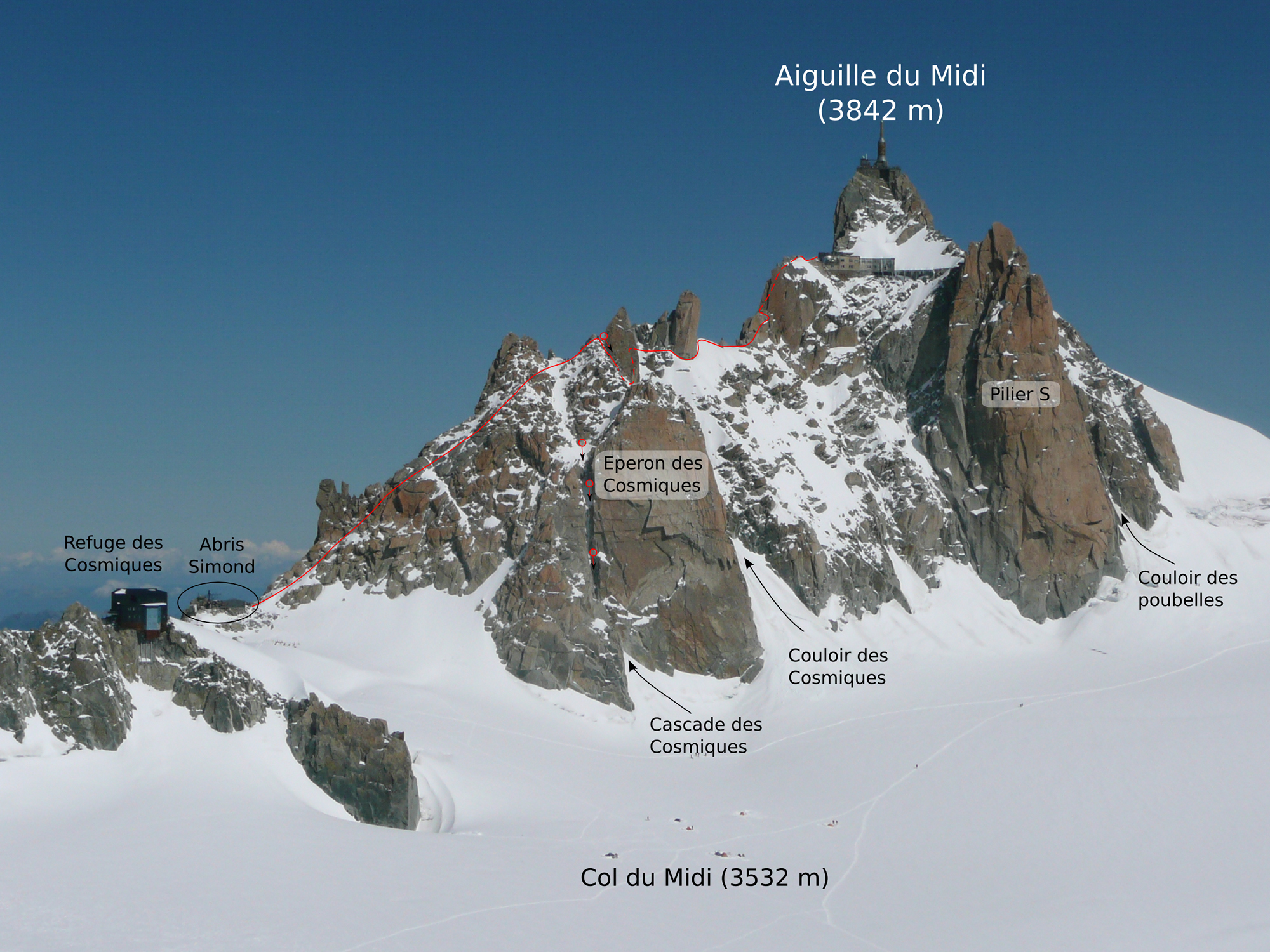
The weather was poor, with visibility down to about 15 meters, persistent snow and a reasonably strong wind which made walking across the galcier the scariest bit of the whole trip, especially when I put my foot partially in a small crevasse just below the Eperon - probably not big enough for me to fall in but it did make me think. I took some shelter behind the Abri Simmond, having a quick bite to eat before setting off.
I left the base at 10:10am (having left the Midi at 9:45/9:50am) and climbed fairly quickly up the first slabbly sectyion. The rock was very snowy and sections were covered in rime. After about 15/20 minutes I was at the first abseil. I though about down-climbing this as I've done several times before but as I needed to get the rope out for the next one decided it was probably quicker an safer to just rappel both. Rigging the second abseil my hands got quite cold having got wet earlier from brushing snow off holds, here I had a bit of a moment as once you do this you are fairly committed to finishing the rest of the ridge, including the crux slab. I went for it and got to the bottom of the gully where I pulled the ropes, here I made a stupid mistake. As I took my sack off to stow the rope I forgot that my axe was behind my back and dropped it and had to downclimb a good 15m to where it was perched precariously between two rocks, this cost me a good 5-10 minutes as I took it quite slowly. After this I soon reached the crux slab where I changed into dry gloves and then went for, the last section on the north side of the ridge went very quickly and by 11am I was slumped infront of the telescope on the viewing platform, 50 minutes after I started.
The guidebook time is 3 hours, so 50 minutes isn't bad, I'm happy with it considering the conditions. I would of really liked to of beaten John's record of 40 minutes, and I think if I did in good conditions I maybe could - but that will have to wait to next year. I really enjoyed doing it and got a huge buzz from moving freely and swiftly on the mountain however I really did feel alone and quite vulnerable if anything did happen (there were no other parties on the ridge), I imagine I'll do some more soloing, but I'm not quite sure how much yet.
Thats the summer alpine season over for me, I've done 7 weeks out in the Alps and got loads done, and in general the summer has been one of the best I've had for climbing with the month I spent climbing Yosemite, Squamish and Nevada before the Alps. Apparently its time to knuckle down and finish my degree now...
Aiguille de L'M NNE Ridge & L'Index SE Ridge
Tuesday myself and Ash took a 9am lift up the Midi and jumped off at the Plan station before heading up towards the Nantillons glacier and then cutting across under the Petit Charmoz to the base of the Aiguille de L'M. The approach is given in most books as about 2 hours, either from the Plan station or the Montenvers train station on the to the other side. We opted for the Plan approach as while it undulates a fair bit as it crosses several lines of moraine its basically a traverse, a appose to the Montenvers approach which is shorter but ivolves a lot more ascent - we planned to use this as out descent route.
 NNE Ridge, Aiguille de L'M.
I led the first pitch, which starts with a few steep moves before some delicate climbing up a shallow crack on a slab. Its given IV- which makes it allegedly one of the harder pitches of the route but despite it being freezing (the sun hadn't come round yet and I couldn't feel my hands!) I thought it was fairly amenable, I strung this together with the next pitch which has some easy III climbing leading to a nice terrace. Here Ash took over and led a fairly short pitch, but with a stiff move (about British 4b/4c) to start up to below the big diedre. This offwidth corner crack is certainly the crux of the route and takes a bit of though as the natural line is to follow and try to climb the offwidth but the way to do is to make a few delicate but easier moves out on the slab which lead to the belay above. This thwarted me the first time, but Ash dispatched with ease, leaving me to follow with both mine and his rucksack which proved quite a challenge! The line on the next pitch is a bit vague and has a few option, I followed a line that passed a few pegs, but Ash found another on second. From here a final pitch led up to the summit ridge and then the summit of the L'M itself. A bit of backtracking leads to a series of abseil anchors, we made three 30m abseils down to the snow gully and then a further one to the other side of the snow and bit of down-climbing to get get us back to the start. We managed to do the descent from here to the Montenvers in 50mins, getting to the station about 10 minutes before the last train.
Clare O'Sullivan arrived that evening so with both myself an Ash being a bit tired from 3 days on the run and Clare having come straight from sea level we took the Midi up and just did a quick lap on the Cosmiques making use of our lift passes, and being down in time for lunch in the Petit Kitchen.
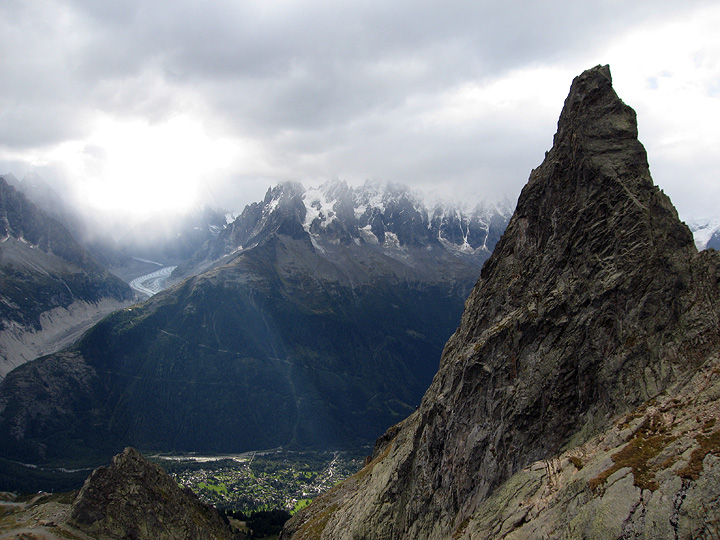
 L'Index, the SE Ridge is the left side of the prominent fin of rock.
The next day we walked down from Chris an Andrea's down to Flegere lift station to get up onto the Aiguille Rouge before the lifts shut at the end of the week and we'd have to start walking up... Alpinistes actually walking somewhere!? I've climbed l'Index twice before, but always done routes on the face rather than the classic but easier ridge-line known as the SE Ridge. We did the approach pitches first that sit below the terrace, these are 5c and then 4c and fully bolted. As I'd done these before Ash lead both of them with me an Clare following. At the terrace we had some lunch before we swapped over and I led up the ridge, which at it's hardest is 4c. Its got much less equipment than the other routes, but theres pegs here and there and a reasonable amount of in-situ nuts an cams. I think I probably only places about 3/4 of my own pieces. its 4/5 pitches in the guidebok but I manged to run bits together and did it in 3 fairly full 60m pitches right to the summit. The route is well travelled, and as a product it is quite polished in places but again there is a reason for this - the route is very good, and while it does detract from the quality it certainly isn'y a reason not to do the route.
Throughout the day we had great views over to the Chappelle route on La Gliere which is a route that I really do recommend to do up on the rouge, 14 pitches of excellent climbing at a moderate grade, the hardest bits being 6a.
 NNE Ridge, Aiguille de L'M.
 I led the first pitch, which starts with a few steep moves before some delicate climbing up a shallow crack on a slab. Its given IV- which makes it allegedly one of the harder pitches of the route but despite it being freezing (the sun hadn't come round yet and I couldn't feel my hands!) I thought it was fairly amenable, I strung this together with the next pitch which has some easy III climbing leading to a nice terrace. Here Ash took over and led a fairly short pitch, but with a stiff move (about British 4b/4c) to start up to below the big diedre. This offwidth corner crack is certainly the crux of the route and takes a bit of though as the natural line is to follow and try to climb the offwidth but the way to do is to make a few delicate but easier moves out on the slab which lead to the belay above. This thwarted me the first time, but Ash dispatched with ease, leaving me to follow with both mine and his rucksack which proved quite a challenge! The line on the next pitch is a bit vague and has a few option, I followed a line that passed a few pegs, but Ash found another on second. From here a final pitch led up to the summit ridge and then the summit of the L'M itself. A bit of backtracking leads to a series of abseil anchors, we made three 30m abseils down to the snow gully and then a further one to the other side of the snow and bit of down-climbing to get get us back to the start. We managed to do the descent from here to the Montenvers in 50mins, getting to the station about 10 minutes before the last train.
Clare O'Sullivan arrived that evening so with both myself an Ash being a bit tired from 3 days on the run and Clare having come straight from sea level we took the Midi up and just did a quick lap on the Cosmiques making use of our lift passes, and being down in time for lunch in the Petit Kitchen.
 L'Index, the SE Ridge is the left side of the prominent fin of rock.
The next day we walked down from Chris an Andrea's down to Flegere lift station to get up onto the Aiguille Rouge before the lifts shut at the end of the week and we'd have to start walking up... Alpinistes actually walking somewhere!? I've climbed l'Index twice before, but always done routes on the face rather than the classic but easier ridge-line known as the SE Ridge. We did the approach pitches first that sit below the terrace, these are 5c and then 4c and fully bolted. As I'd done these before Ash lead both of them with me an Clare following. At the terrace we had some lunch before we swapped over and I led up the ridge, which at it's hardest is 4c. Its got much less equipment than the other routes, but theres pegs here and there and a reasonable amount of in-situ nuts an cams. I think I probably only places about 3/4 of my own pieces. its 4/5 pitches in the guidebok but I manged to run bits together and did it in 3 fairly full 60m pitches right to the summit. The route is well travelled, and as a product it is quite polished in places but again there is a reason for this - the route is very good, and while it does detract from the quality it certainly isn'y a reason not to do the route.
Throughout the day we had great views over to the Chappelle route on La Gliere which is a route that I really do recommend to do up on the rouge, 14 pitches of excellent climbing at a moderate grade, the hardest bits being 6a.
Subscribe to:
Posts (Atom)


